Module 1: What Is Eschatology? Four Views
Let me start with a story.
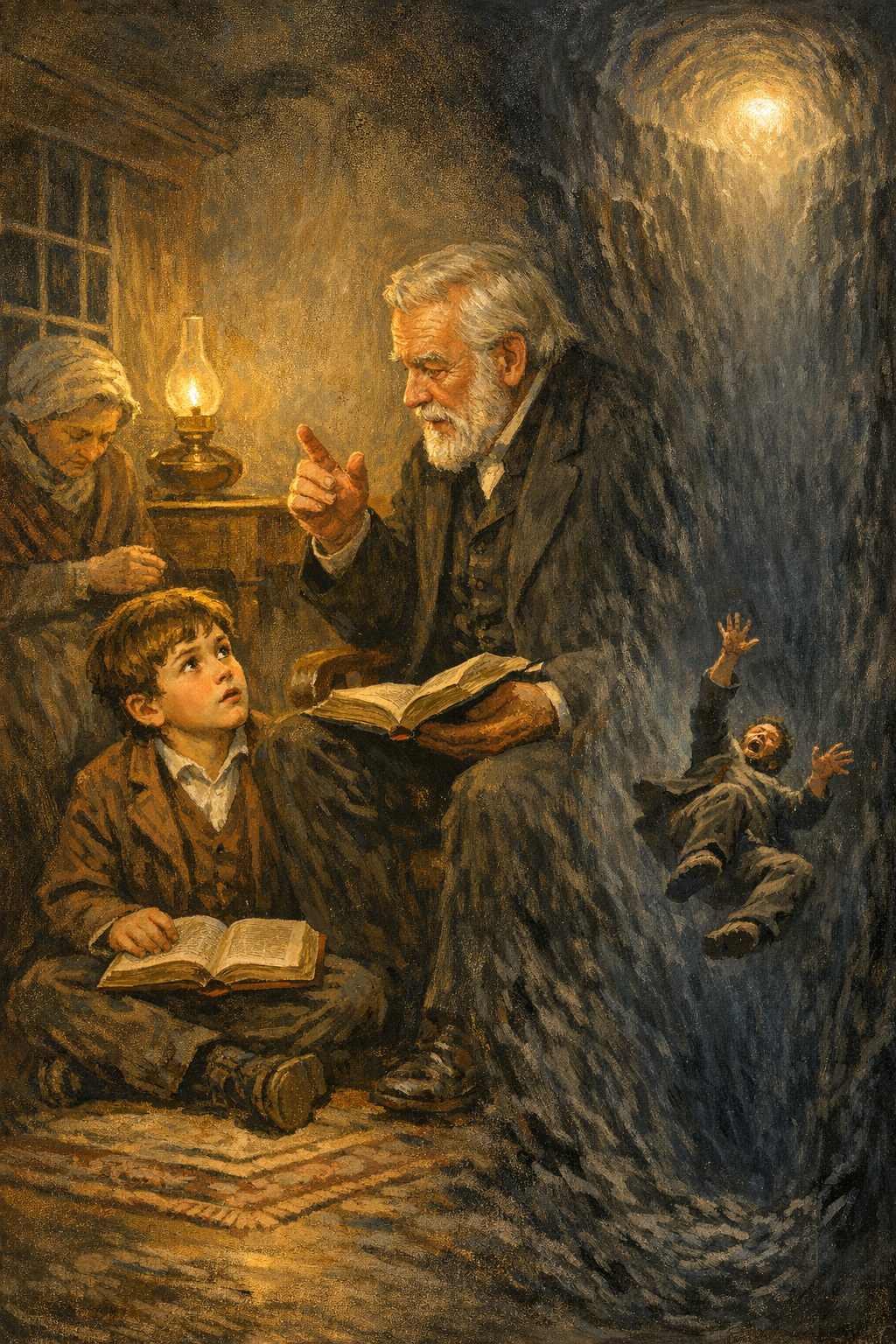
Charles Spurgeon - the great Victorian preacher who packed the Metropolitan Tabernacle in London with thousands of people every Sunday - was once a curious little boy sitting at his grandfather's feet during family prayer time. One evening, he was reading through Revelation and came across a passage about something called the bottomless pit. He asked his grandfather what that meant. His grandfather told him to read on. He wasn't satisfied. He kept coming back to it, day after day, until his grandfather finally gave him an answer.
Spurgeon never forgot what his grandfather said. He described it this way: there is a pit, and the soul is falling down - falling fast. The last ray of light disappears. It falls on and on, for a thousand years, and it is still no nearer the bottom. Because it is bottomless. On and on, forever.
That image shaped Spurgeon for the rest of his life. It is also a fitting entry point into what we are studying in this course - because that boy's question, 'What does this mean?' is exactly the question the church has been asking about the end times for two thousand years. And the church has not always agreed on the answer.
estion that, as we will see, Spurgeon answered in a way that still challenges and instructs us today.
So What Is Eschatology?
Eschatology is the branch of Christian theology that deals with the last things. The word comes from the Greek eschatos, meaning 'last' or 'final.' Eschatology asks the questions: How does history end? What happens when we die? What does the Bible say about the return of Christ, the resurrection of the dead, the final judgment, heaven, and hell?
Every serious Christian tradition has an eschatology, whether they know it or not. When you confess in the Apostles' Creed that Christ will come again to judge the living and the dead, you are making an eschatological claim. The question is not whether you have an eschatology. The question is whether yours is anchored in Scripture and informed by the long conversation the church has been having about these things.
The Millennium: The Pivot Point of the Debate
Most of the disagreement in Christian eschatology centers on one passage: Revelation 20. In that chapter, John describes a period of a thousand years - what has come to be called the millennium - during which Christ reigns and Satan is bound. It is only six verses long. But those six verses have generated more theological debate than almost any other passage in the New Testament.
The debate is not about whether Christ is coming back. Every serious Christian tradition agrees on that. The debate is about when the millennium happens, what it consists of, and who is involved in it. And out of that debate, four major positions have emerged.
The Four Positions in Plain Language
Amillennialism holds that the millennium is not a future event but a present reality. The thousand years is a symbolic description of the current age between Christ's first and second comings. Christ is already reigning from heaven. Satan is already bound in the sense that he cannot stop the advance of the gospel to the nations. When Christ returns, all the end-time events - resurrection, judgment, the new heaven and new earth - happen at once. There is no earthly golden age still to come.
Historic Premillennialism holds that Christ will return before the millennium, which will then be a literal period of Christ's reign on earth. Before His return there will be a time of great tribulation. The church will pass through that tribulation. At Christ's return, believers will be resurrected and will reign with Him for a thousand years. After the millennium, Satan will be released briefly, defeated, and cast into the lake of fire, followed by the final resurrection and judgment. Crucially, this view holds that the Jewish people will turn to Christ and enter the church - there is no separation between Israel and the church in the millennium.
Dispensational Premillennialism (also known as Pretribulational Premillennialism) agrees that Christ returns before a literal millennium, but adds a critical distinction: the church will be secretly raptured before a seven-year tribulation begins. After the tribulation, Christ returns with His saints to establish the millennium. In its original form, this view maintained a sharp distinction between Israel and the church as two separate peoples of God with two distinct futures. The millennium, in this view, is in part about fulfilling the literal, national promises God made to Israel in the Old Testament.
Postmillennialism takes the most optimistic view of the gospel's power in history. It holds that as the gospel spreads throughout the earth, it will gradually transform the nations, ushering in a golden age of peace and righteousness - the millennium. This golden age precedes Christ's return. When Christ does return, it will be to a world that has largely been won for Him. The final resurrection and judgment then take place.
The Question That Unlocks Everything
Here is the single most useful question for understanding any eschatological position: What does this view believe about the future role of the Jewish people in the millennium?
Amillennialism says there is no future role - the church is the new Israel, and the physical promises to the Jewish nation are fulfilled spiritually in the church. Postmillennialism allows for a future conversion of the Jewish people but not a national restoration to the land. Historic Premillennialism expects both a physical return to the land and a conversion into the church, with Jewish and Gentile believers together in Christ's kingdom. Dispensationalism expects both a return to the land and a national revival, but maintains a distinction between Israel and the church even in the millennium.
This question - Israel's role in the millennium - will be our thread throughout this entire course. It is the clearest lens for understanding what each position actually believes. And it is the question that, as we will see, Spurgeon answered in a way that still challenges and instructs us today.
Stop & Think:
Before this course, which of the four views - if any - did you assume was correct?
Where did that assumption come from?
A sermon you heard?
A book you read?
A movie like Left Behind?
Or did you simply not know there were multiple views?
For me, it was the default position of my church; it was the only thing that was taught. I did not know there were other positions.
You like have absorbed a position from your church, a book, teacher, conference, or even the notes in your study Bible. Let’s just acknowledge this openly and non-judgmentally. The goal is not to make anyone feel foolish but to create awareness that their default position has a history. We are going to study this history, and hopefully by the end, wherever you land, it will be a place you can defend biblically, historically, and systematically. (Those are the three major fields of theology - more on that in another course.)